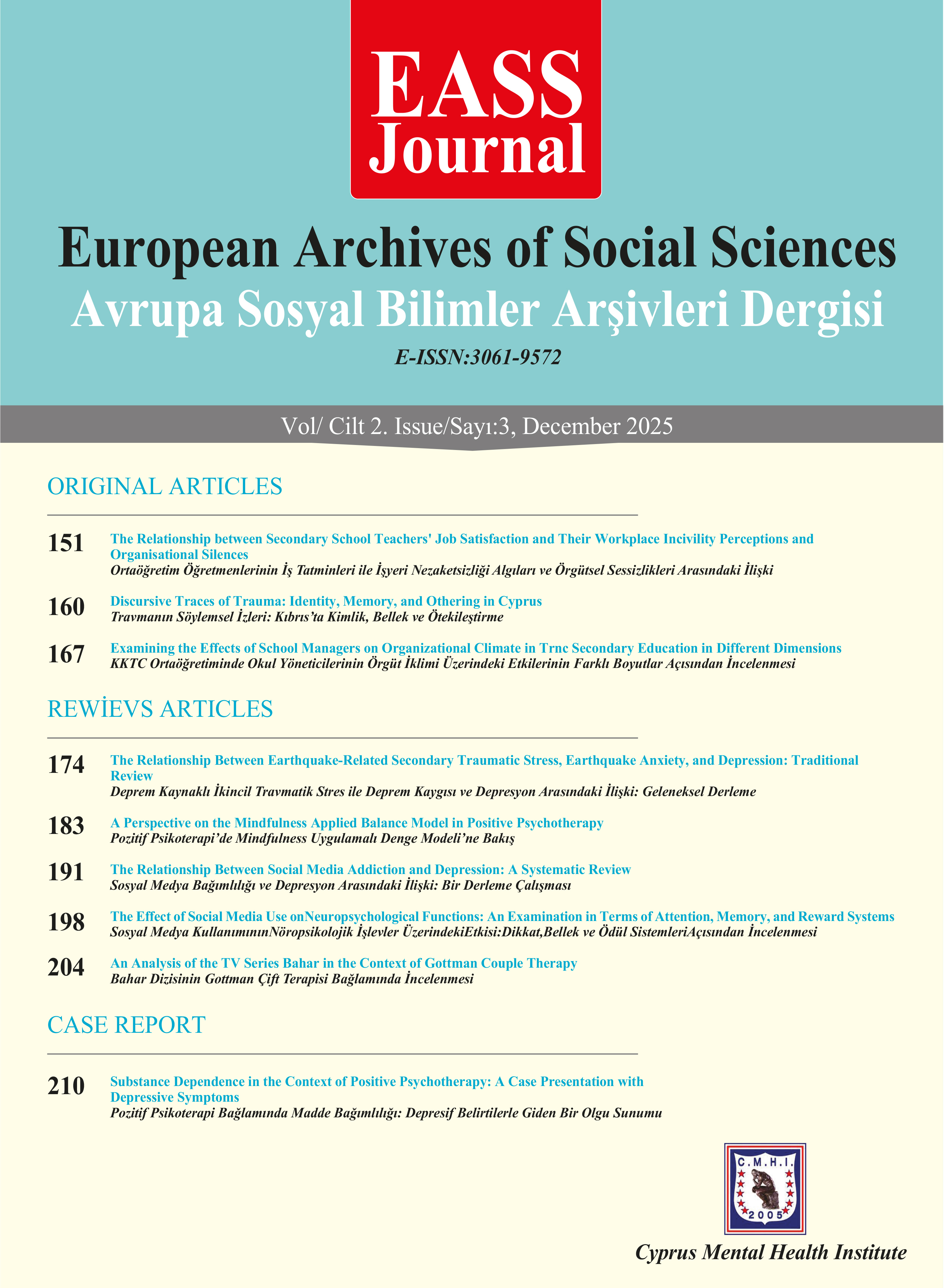
KKTC Ortaöğretiminde Okul Yöneticilerinin Örgüt İklimi Üzerindeki Etkilerinin Farklı Boyutlar Açısından İncelenmesi
DOI:
https://doi.org/10.35365/eass.25.3.03Anahtar Kelimeler:
Kuzey Kıbrıs, Örgütsel İklim, Okul Yöneticisi ve ÖğretmenÖzet
Bu araştırmanın amacı, Kuzey Kıbrıs Türk Cumhuriyeti Milli Eğitim Bakanlığı’na bağlı ortaöğretim okullarında okul yöneticilerine örgütsel iklime etkilerinin farklı boyutlarda incelemesini sağlamaktadır. Bu değerlendirme okul yöneticilerinin ve öğretmenlerin örgütsel iklime karşı bakış açılarını anlamayı amaçlamaktadır. Bu araştırma, okul reformları, hesap verebilirliğinden sorumlu eğitim bakanlıkları ve kurumları için farklı bir öneme sahiptir. Araştırma, KKTC Milli Eğitim Bakanlığı'na bağlı orta öğretim kademesinde Lefkoşa, Gazimağusa, Girne, Güzelyurt ve İskele ilçelerinde görev alan 10 okul yöneticisi ve 40 öğretmenini kapsamaktadır. Araştırmada, nitel araştırma yaklaşımı kullanılmış ve bu yaklaşım içerisinde durum çalışması desenine başvurulmuştur. Araştırmacı, yarı yapılandırılmış sorulardan oluşan görüşme yöntemini kullanmış ve bu amaçla on bir adet yarı yapılandırılmış sorudan oluşan iki görüşme formu alanda çalışan beş uzmanında görüşü alınarak geliştirilmiştir. Veri toplama aracı olarak bu görüşme formu kullanılmıştır. Nitel veri analizi yöntemlerinden betimsel analiz ve içerik analizi teknikleri kullanılmıştır. Elde edilen bulgular öğretmenler; dönüşümsel liderliğin, okul yöneticilerinin disiplinli ve destekleyici bir ortamı sürdürmedeki rolünü vurgulayarak olumlu bir okul atmosferini teşvik ettiği yönünde görüş belirtmiştir. Öğretmenlerin, sıklıkla ayrımcılık yapmayan tekniklerin ve eşit görev dağılımının önemini vurguladıkları ortaya çıkmaktadır. Okul yöneticilerinin, eşit görev dağılımı elde etmek için görev rotasyonu ve personel geri bildirimi toplama gibi tekniklerin ve taktiklerin eğitimin bir hassa yönetim boyutunda kullanılması gerekliliği ortaya çıkmaktadır. Okul yöneticileri bir örgüt olarak okulun ikliminin etkili iletişimle ve örgüt içerinde motivasyonun artmasına yönelik çalışmalar gerçekleştirilmesi gerekliliği sonuçlarına ulaşılmıştır. Bu araştırma okul iklimine yönelik görüşleri okul yöneticisi ve öğretmen perspektifleriyle sunarken, gelecekteki çalışmalar değişen liderlik stillerinin okul atmosferi üzerindeki uzun vadeli etkilerini yönelik nicel yaklaşımları içeren sayısal verilere dayanan deneysel araştırma gerçekleştirilebilir.
Referanslar
Arslan, E. (2022). Nitel Araştirmalarda Geçerlilik ve Güvenilirlik. Pamukkale Üniversitesi Sosyal Bilimler Enstitüsü Dergisi, (51), 395-407. https://doi.org/10.30794/pausbed.1116878
Aziz, A. (2011). Sosyal bilimlerde araştırma yöntemleri ve teknikleri. Nobel Akademik Yayıncılık. ISBN: 978-605-133-155-3
Baş, Ö., & Gök, B. (2024). Nitel araştırma pratikleri (eğitimciler için). Pegem Akademi.Ankara. ISBN: Barkod : 9786256128972
Büyüköztürk, Ş., Kılıç Çakmak, E., Akgün, Ö. A., Karadeniz, Ş., & Demirel, F. (2024). Bilimsel araştırma yöntemleri. Ankara: Pegem Akademi Yayınları. 36. Baskı. ISBN 978-9944-919-28-9
Campbell, C. (2021). Leading large-scale educational change in the twenty-first century: Educational leadership pre-, during, and post-pandemic. In Future alternatives for educational leadership (pp.143-161).Routledge. https://doi.org/10.4324/9781003131496
Etikan, I., Musa, S. A., & Alkassim, R. S. (2016). Comparison of convenience sampling and purposive sampling. American journal of theoretical and applied statistics, 5(1), 1-4. ISSN: 2326-8999 (Print);ISSN:2326-9006(Online)
Hoy, WK, Tarter, CJ ve Kottkamp, RB (1991). Açık Okullar, Sağlıklı Okullar: Örgütsel İklimi Ölçmek. Sage Yayınları.
Gürlek, M., & Onbaşılı, Ü. İ. (2024). Examination of the Relationship between Epistemic Curiosity Levels and Academic Motivation of Classroom Teacher Candidates 1. Egitim Bilimleri Fakultesi Dergisi, 57(1), 61-97. DOI:10.30964
Lahtero, T.J. ve Risku, M. (2021). Finlandiya Ortaokullarında Öğretim Liderliği. Uluslararası Eğitimde Liderlik Dergisi, 24(2), 200–213. https://doi.org/10.37455/tt.95779
Leithwood, K., Harris, A., & Hopkins, D. (2020). Seven strong claims about successful school leadership revisited. School leadership & management, 40(1), 5-22. https://doi.org/10.1080/13632434.2019.1596077
Karahan, S., Uca, S., & Güdük, T. (2022). Nitel araştırmalarda görüşme türleri ve görüşme tekniklerinin uygulanma süreci/Interviews and interviewing techniques in qualitative research. Nitel Sosyal Bilimler, 4(1), 78-101. https://doi.org/10.47105/nsb.1118399
Kutsyuruba, B., Godden, L., & Bosica, J. (2019). The impact of mentoring on the Canadian early career teachers’ well-being. International Journal of Mentoring and Coaching in Education, 8(4), 285-309. https://doi.org/10.1108/IJMCE-02-2019-0035
Netolicky, D. M. (2020). School leadership during a pandemic: navigating tensions. Journal of professional capital and community, 5(3/4), 391-395. https://doi.org/10.1108/JPCC-05-2020-0017
Türnüklü, A. (2000). Eğitim bilim araştırmalarında etkin olarak kullanılabilecek nitel bir araştırma tekniği: Görüşme. Kuram ve uygulamada eğitim yönetimi, 24(24), 543-559.
Wang, M.T. ve Degol, J.L. (2016). Okul iklimi: Yapının, ölçümün ve öğrenci sonuçları üzerindeki etkisinin incelenmesi. Eğitim Psikolojisi İncelemesi, 28(2), 315–352. https://doi.org/10.1007/s10648-015-9319-1
Yıldırım, A., & Simsek, H. (1999). Sosyal bilimlerde nitel araştırma yöntemleri (11 baski: 1999-2018). dc.identifier. isbn 9781111148461
Yıldırım, A., & Şimşek, H. (2021). Sosyal Bilimlerde Nitel Araştırma Yöntemleri.(12. Genişletilmiş Baskı) Ankara: Seçkin Yayınevi. ISBN: 9789750269820
İndir
Çevrimiçi Yayın Tarihi
Nasıl Atıf Yapılır
Sayı
Bölüm
Lisans
Telif Hakkı (c) 2025 Bağcan Batunlu, Sonay Dericioğlu

Bu çalışma Creative Commons Attribution 4.0 International License ile lisanslanmıştır.






 Dergimizde yayımlanan makaleler,