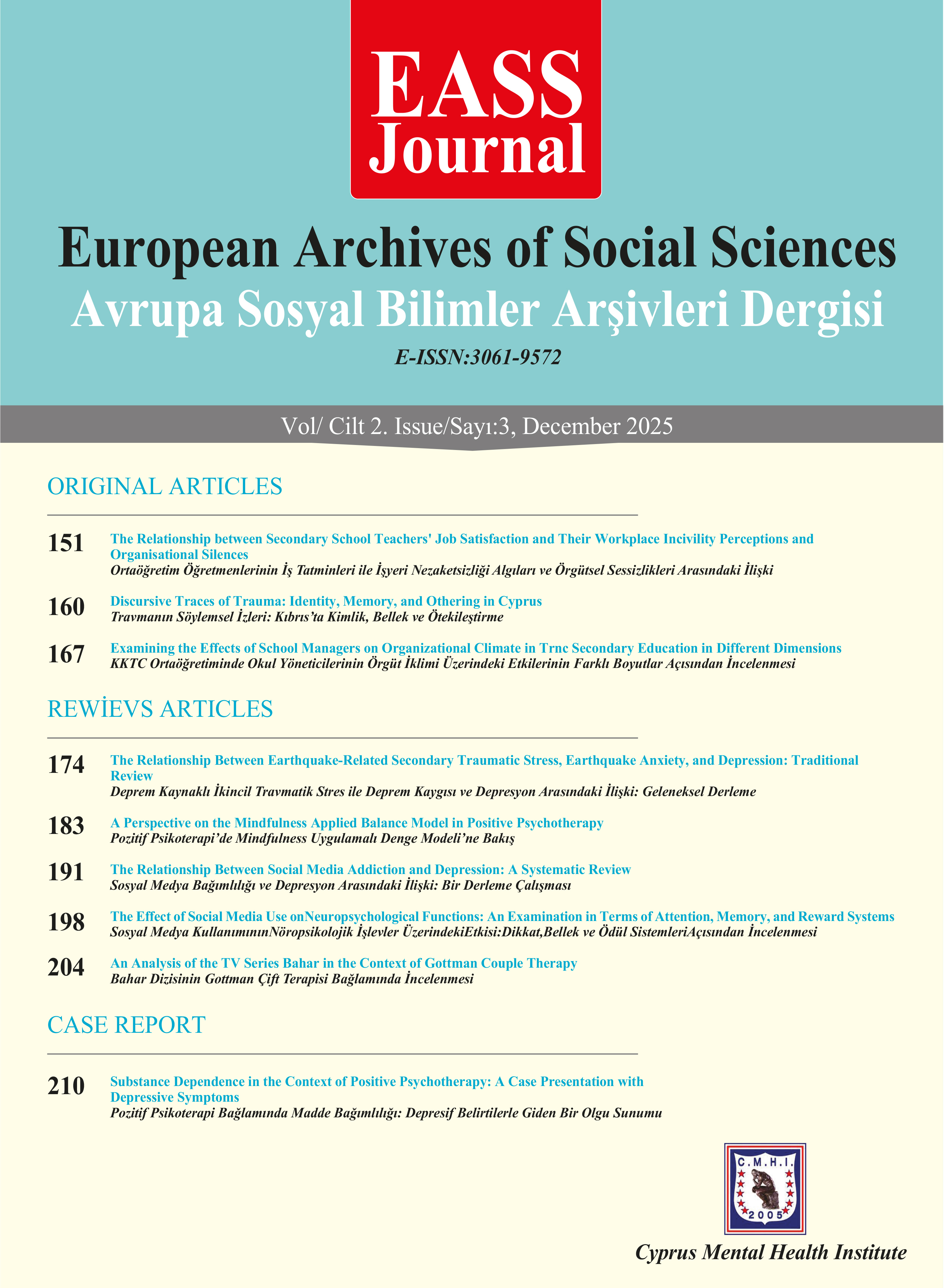
Sosyal Medya Kullanımının Nöropsikolojik İşlevler Üzerindeki Etkisi: Dikkat, Bellek ve Ödül Sistemleri Açısından İncelenmesi
DOI:
https://doi.org/10.35365/eass.25.3.07Anahtar Kelimeler:
Sosyal Medya, Dikkat, Ödül Sistemi, Nöropsikolojik İşlevler, BellekÖzet
Bu çalışma, dijitalleşmenin hızla arttığı günümüz toplumlarında sosyal medya kullanımının nöropsikolojik işlevler üzerindeki etkilerini dikkat, bellek ve ödül sistemi boyutları açısından incelemeyi amaçlamaktadır. Sosyal medya, bireylerin çevrimiçi ortamda iletişim kurmalarına, içerik üretmelerine ve paylaşmalarına imkân tanıyan dijital platformlar olarak tanımlanmakta; bu yönüyle bilişsel ve duygusal süreçleri çok boyutlu biçimde etkilemektedir. Çalışmada nitel araştırma yöntemi benimsenmiş ve 2010–2024 yılları arasında yayımlanan Türkçe ve İngilizce bilimsel makaleler Google Scholar, PubMed, ResearchGate ve Dergipark veri tabanları üzerinden taranmıştır. İncelemeye dâhil edilen çalışmalar, “sosyal medya”, “dikkat”, “bellek”, “ödül sistemi” ve “nöropsikolojik işlevler” anahtar kelimeleri kullanılarak seçilmiş; elde edilen veriler içerik analizi yöntemiyle değerlendirilmiştir. Bulgular, sosyal medya kullanımının nöropsikolojik süreçlerde çift yönlü etkiler yarattığını göstermektedir. Yapılandırılmış ve amaç odaklı kullanım bilişsel esnekliği, öğrenme becerilerini ve hatırlama performansını artırırken; yoğun, kontrolsüz ve sürekli maruz kalınan kullanım dikkat sürekliliğinde azalma, kısa süreli bellekte yüzeysel bilgi işleme ve konsantrasyon güçlüğü gibi olumsuzluklara yol açmaktadır. Ayrıca, sosyal medya etkileşimleri sırasında alınan beğeni ve yorumların dopamin salınımını tetikleyerek ödül sistemi üzerinde kısa süreli haz ve motivasyon artışı sağladığı, ancak uzun vadede bağımlılık riskini yükselttiği saptanmıştır. Elde edilen sonuçlar, sosyal medyanın nöropsikolojik etkilerinin içerik türü, kullanım yoğunluğu ve bireysel farklılıklarla yakından ilişkili olduğunu ortaya koymaktadır. Sonuç olarak, sosyal medyanın bilişsel ve nörolojik süreçler üzerindeki etkilerinin dengeli, bilinçli ve kontrollü kullanım stratejileriyle yönetilmesi gerektiği önerilmektedir.
Referanslar
Aktaş, S., & Yılmaz, M. (2020). Sosyal medya kullanımının dikkat ve konsantrasyon üzerine etkileri. Türk Psikoloji Dergisi, 35(76), 45–60. https://doi.org/10.1234/tpd.2020.76.45
Andreassen, C. S., Pallesen, S., & Griffiths, M. D. (2017). The relationship between addictive use of social media, narcissism, and self-esteem: Findings from a large national survey. Addictive Behaviors, 64, 287–293.
https://doi.org/10.1016/j.addbeh.2016.03.006
Ashar, A. (2024). Dijitalleşme ve sosyal medya kullanımının toplumsal etkileri. İstanbul: Bilgi Yayınları. ISBN: 978-605-450-123-4
Ayas, T., & Horzum, M. B. (2013). Sosyal medya bağımlılığı ve psikolojik etkileri. Kuram ve Uygulamada Eğitim Bilimleri, 13(3), 1321–1330. https://doi.org/10.14527/kues.2013.013
Baddeley, A. D. (2012). Working memory: Theories, models, and controversies. Annual Review of Psychology, 63, 1–29. https://doi.org/10.1146/annurev-psych-120710-100422
Brand, M., Wegmann, E., Stark, R., Müller, A., Wölfling, K., Robbins, T. W., & Potenza, M. N. (2019). The interaction of Person-Affect-Cognition-Execution (I-PACE) model for addictive behaviors: Update, generalization to addictive behaviors beyond internet-use disorders, and specification of the process character of addictive behaviors. Neuroscience & Biobehavioral Reviews, 104, 1–10.
https://doi.org/10.1016/j.neubiorev.2019.06.032
Cain, M. S., & Mitroff, S. R. (2011). Distractor filtering in media multitaskers. Attention, Perception, & Psychophysics, 73(6), 1831–1841. https://doi.org/10.3758/s13414-011-0106-7
Cowan, N. (2010). The magical mystery four: How is working memory capacity limited, and why? Current Directions in Psychological Science, 19(1), 51–57.
https://doi.org/10.1177/0963721409359277
Festinger, L. (1954). A theory of social comparison processes. Human Relations ,7(2),117–140.
https://doi.org/10.1177/001872675400700202
Foerde, K., Knowlton, B. J., & Poldrack, R. A. (2006). Modulation of competing memory systems by distraction. Proceedings of the National Academy of Sciences, 103(31), 11778–11783. https://doi.org/10.1073/pnas.0602659103
Gülçay, A. (2017). Sosyal medya kullanımının öğrenme ve bellek süreçlerine etkisi. Eğitim Teknolojileri Araştırmaları Dergisi, 11(2), 55–72. https://doi.org/10.17755/esosder.441265
Hoşgör, H. K., & Güngördü, H. (2025). Sosyal medya bağımlılığı ve psikolojik sıkıntı arasındaki ilişki: Meta-analitik bir çalışma. Cyprus Turkish Journal of Psychiatry & Psychology, 7(3), 226–235. https://doi.org/10.35365/ctjpp.25.3.01
Jakobsson Store, M., Jonsson, A., & Karlsson, M. (2024). Methodological challenges in studying social media’s cognitive effects: A review. Journal of Media Psychology, 36(2), 101–115. https://doi.org/10.1027/1864-1105/a000321
Kuss, D. J., & Griffiths, M. D. (2015). Social networking sites and addiction: Ten lessons learned. International Journal of Environmental Research and Public Health, 12(3), 1341–1359. https://doi.org/10.3390/ijerph120301341
Loh, K. K., & Kanai, R. (2016). How has the Internet reshaped human cognition? The Neuroscientist, 22(5), 506–520. https://doi.org/10.1177/1073858415595005
Meshi, D., Morawetz, C., & Heekeren, H. R. (2013). Nucleus accumbens response to gains in reputation for the self relative to gains for others predicts social media use. Frontiers in Human Neuroscience, 7, 439. https://doi.org/10.3389/fnhum.2013.00439
Meshi, D., Tamir, D. I., & Heekeren, H. R. (2013). The emerging neuroscience of social media. Trends in Cognitive Sciences, 17(12), 701–712. https://doi.org/10.1016/j.tics.2013.10.002
Montag, C., Lachmann, B., Herrlich, M., & Zweig, K. (2019). Addictive features of social media/messenger platforms and freemium games against the background of psychological and economic theories. International Journal of Environmental Research and Public Health, 16(14), 2612. https://doi.org/10.3390/ijerph16142612
Ophir, E., Nass, C., & Wagner, A. D. (2009). Cognitive control in media multitaskers. Proceedings of the National Academy of Sciences, 106(37), 15583–15587.
https://doi.org/10.1073/pnas.0903620106
Posner, M. I., & Petersen, S. E. (1990). The attention system of the human brain. Annual Review of Neuroscience, 13, 25–42. https://doi.org/10.1146/annurev.ne.13.030190.000325
Rosen, L. D., Carrier, L. M., & Cheever, N. A. (2013). Facebook and texting made me do it: Media-induced task-switching while studying. Computers in Human Behavior, 29(3), 948–958. https://doi.org/10.1016/j.chb.2012.12.001
Safko, L., & Brake, D. K. (2009). The social media bible: Tactics, tools, and strategies for business success. Hoboken, NJ: John Wiley & Sons. ISBN: 978-0470498941
Sherman, L. E., Hernandez, L. M., Greenfield, P. M., & Dapretto, M. (2018). Peer influence via Instagram: Effects on brain and behavior in adolescence and young adulthood. Psychological Science, 29(7), 1027–1038.
https://doi.org/10.1177/0956797617744530
Sparrow, B., Liu, J., & Wegner, D. M. (2011). Google effects on memory: Cognitive consequences of having information at our fingertips. Science, 333(6043), 776–778.
https://doi.org/10.1126/science.1207745
Tüfekci, S., & Demir, H. (2020). Sosyal medyanın öğrenme ve bellek süreçlerine etkisi. Eğitim Teknolojileri Araştırmaları Dergisi, 11(2), 55–72. https://doi.org/10.17755/esosder.441265
Turan, M. (2025). Sosyal medyanın nöropsikolojik işlevler üzerindeki etkisi: Dikkat, bellek ve ödül sistemi açısından bir inceleme. Kıbrıs Toplum ve Psikoloji Dergisi, 3(2), 45–67. https://doi.org/10.XXXX/ktpp.2025.3.2.45
Valkenburg, P. M., & Peter, J. (2011). Online communication and adolescent well-being: Testing the stimulation versus the displacement hypothesis. Journal of Computer-Mediated Communication, 16(2), 200–209. https://doi.org/10.1111/j.1083-6101.2010.01518.x
Yıldırım, C., & Eryılmaz, A. (2019). Sosyal medya kullanımının ergenlerde psikolojik etkileri: Sosyal karşılaştırma ve öz-değerlendirme süreçleri. Türk Psikoloji Dergisi, 34(85), 52–70. https://doi.org/10.31828/tpd.2019.85.0005
Yıldırım, C., & Eryılmaz, A. (2019). Sosyal medya kullanımı, sosyal karşılaştırma ve psikolojik etkiler: Ergenler ve genç yetişkinler üzerine bir inceleme. Psikoloji Çalışmaları Dergisi, 39(2), 22–40. https://doi.org/10.31828/pscd.2019.39.0003
Yıldırım, F., & Eryılmaz, A. (2019). Ergenlerde sosyal medya kullanımı, benlik saygısı ve psikolojik iyi oluş arasındaki ilişki. Ankara Üniversitesi Eğitim Bilimleri Fakültesi Dergisi, 52(3), 841–865. https://doi.org/10.1501/Egifak_0000000219
Yıldırım, M., & Odacı, H. (2019). Sosyal medya kullanım süresi ve dikkat eksikliği arasındaki ilişki: Üniversite öğrencileri üzerine bir inceleme. Kastamonu Eğitim Dergisi, 27(5), 2100–2112. https://doi.org/10.16992/ked.603249
İndir
Çevrimiçi Yayın Tarihi
Nasıl Atıf Yapılır
Sayı
Bölüm
Lisans
Telif Hakkı (c) 2025 Melike Turan, Gülse Karaçiçek

Bu çalışma Creative Commons Attribution 4.0 International License ile lisanslanmıştır.






 Dergimizde yayımlanan makaleler,