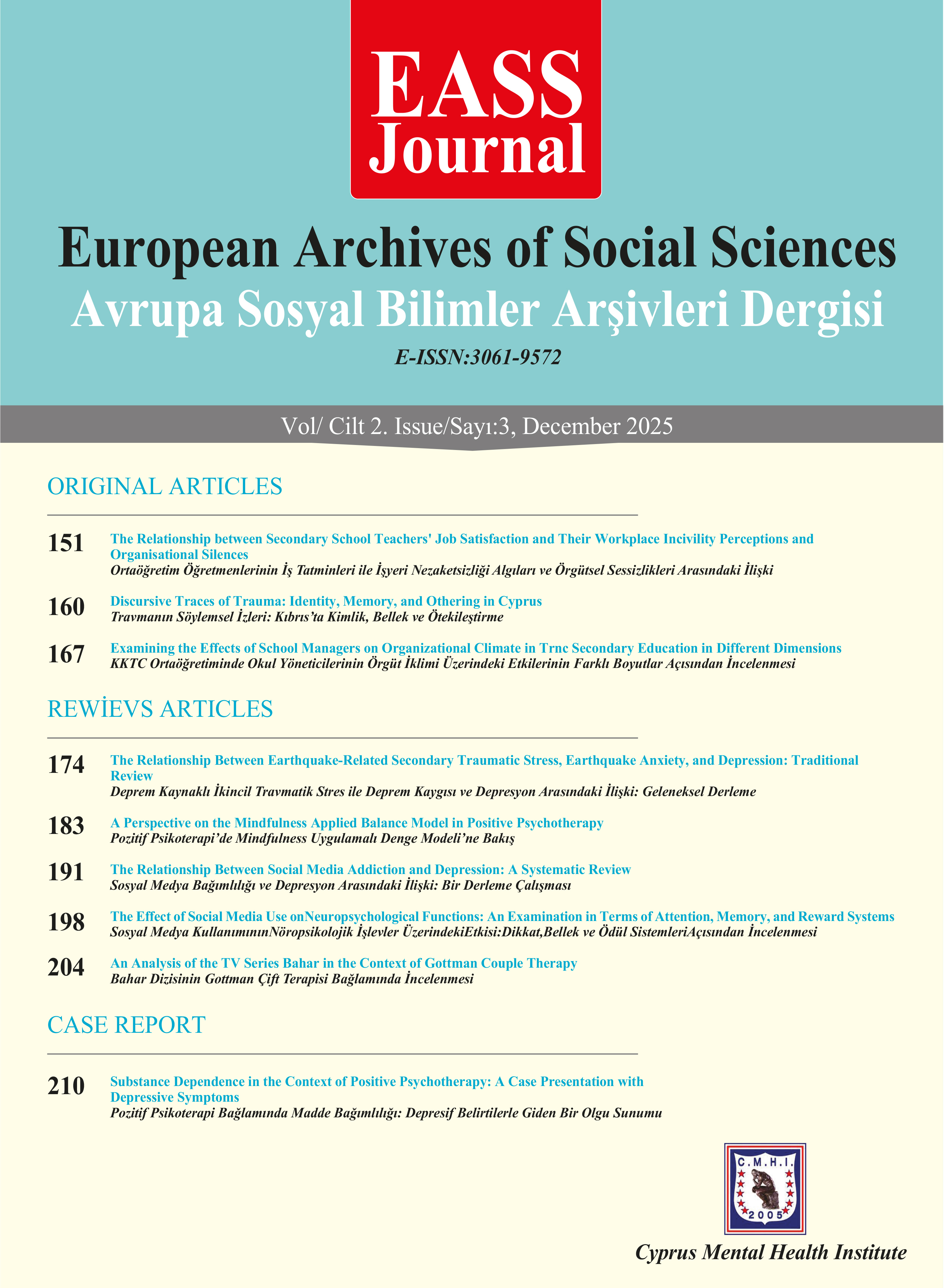
Deprem Kaynaklı İkincil Travmatik Stres ile Deprem Kaygısı ve Depresyon Arasındaki İlişki: Geleneksel Derleme
DOI:
https://doi.org/10.35365/eass.25.3.04Anahtar Kelimeler:
Deprem, İkincil travmatik stres, Deprem kaygısı, DepresyonÖzet
Depremler, yalnızca fiziksel yıkıma yol açan jeolojik olaylar değil; aynı zamanda bireyler ve toplum üzerinde önemli psikolojik etkiler oluşturan çok boyutlu afetlerdir. Depremin doğrudan etkilediği kişilerde travma sonrası stres bozukluğu (TSSB), kaygı ve depresyon gibi ruhsal sorunlar yaygın olarak görülürken; afet bölgesinde bulunmayan ancak depremle ilgili haberler, görüntüler veya travmatik anlatımlara maruz kalan bireylerde ikincil travmatik stres gelişebilmektedir. Bu çalışmada, geleneksel derleme yöntemi kullanılarak deprem kaynaklı ikincil travmatik stres ile deprem kaygısı ve depresyon arasındaki ilişki literatür doğrultusunda incelenmiştir. Literatür taraması, Google Scholar, DergiPark Akademik, PubMed ve Ulusal Tez Merkezi veri tabanları üzerinden yapılmış ve çalışmada “deprem”, “ikincil travmatik stres”, “deprem kaygısı” ve “depresyon” anahtar kelimeleri kullanılmıştır. Çalışmadan elde edilen bulgular, Türkiye’de gerçekleştirilen yedi araştırmaya dayanmaktadır. Araştırmalar, deprem kaynaklı ikincil travmatik stres ile deprem kaygısı ve depresyon arasında anlamlı ve pozitif yönlü ilişkiler olduğunu göstermektedir. Ayrıca, ikincil travmatik stresin hem deprem kaygısını hem de depresyonu güçlendirdiği ve bu üç değişkenin birbirini karşılıklı olarak etkilediği saptanmıştır. Özellikle afet sonrası dönemde yaşanan belirsizlik, kontrol kaybı, tekrar deprem olacağı beklentisi, depremi yaşamış bireylerin yaşantılarına tanıklık etme gibi durumlar; depremi doğrudan yaşamamış bireylerde de deprem kaynaklı travmatik stres, deprem kaygısı ve depresyonun oluşmasına katkıda bulunabilmektedir. Dolayısıyla, ikincil travmaya maruz kalan bireylerde kaygı ve depresyon düzeylerinin artması olasıdır. Bu nedenle, afet sonrası psikososyal müdahalelerde yalnızca doğrudan etkilenen bireyler değil; travmaya dolaylı olarak maruz kalan toplum kesimleri de psikolojik destek programlarına dahil edilmelidir.
Referanslar
AFAD. (2023). 6 Şubat 2023 Kahramanmaraş depremleri bilgilendirme raporu. Retrieved August 10, 2023, from https://deprem.afad.gov.tr/last-earthquakes.html
AFAD (2025). Açıklamalı afet yönetimi terimleri sözlüğü.Retrieved August 14, 2025, from:
https://www.afad.gov.tr/aciklamali-afet-yonetimi-terimleri-sozlugu
AFAD [T.C. İçişleri Bakanlığı Afet ve Acil Durum Yönetimi Başkanlığı] (2022). 10. yılında Ulusal Deprem Stratejisi ve Eylem Planı (UDSEP-2023). Retrieved: September 1, 2025, from https://deprem.afad.gov.tr/assets/pdf/10yil_UDSEP_KITAP_13062022.pdf
Akman, E. E. (2023). Bir üniversite hastanesinde depremzede hastalara hizmet veren sağlık çalışanlarının ikincil travmatik stres, depresyon ve anksiyete düzeylerinin değerlendirilmesi (Thesis No. 848364) [Medical specialty thesis, Sivas Cumhuriyet University]. YÖK Tez Merkezi. Retrieved September 17, 2023, from https://tez.yok.gov.tr/UlusalTezMerkezi
Alipour, F., & Ahmadi, S. (2020). Social support and Posttraumatic Stress Disorder (PTSD) in earthquake survivors: A systematic review. Social Work in Mental Health, 18(5), 501–514. https://doi.org/10.1080/15332985.2020.1795045
APA [Amerikan Psikiyatri Birliği] (2014). Ruhsal Bozuklukların Tanımsal ve Sayımsal El Kitabı, Beşinci Baskı (DSM-5). E. Köroğlu (Çev. Ed.), Tanı Ölçütleri Başvuru El Kitabı’ndan, Hekimler Yayın Birliği. ISBN-13 978-0890425558
Bonanno, G. A., Brewin, C. R., Kaniasty, K., & Greca, A. M. L. (2010). Weighing the costs of disaster: Consequences, risks, and resilience in individuals, families, and communities. Psychological Science in The Public Interest, 11(1), 1-49. https://doi.org/10.1177/1529100610387086
Bozkurt, E. (2001). Neotectonics of Turkey–a synthesis. Geodinamica Acta, 14(1-3), 3-30.
https://doi.org/10.1080/09853111.2001.11432432
Bulut, A. (2023). Doğal afetler ve ruh sağlığı ilişkisi. Kıbrıs Türk Psikiyatri ve Psikoloji Dergisi, 5(3), 265-273.
https://doi.org/10.35365/ctjpp.23.3.09
Cansel, N., Sandıklı, H., Melez, Ş. N. İ., Sandıklı, M., Balıkçı Çiçek, İ., & Kayhan Tetik, B. (2025). Evaluation of post-traumatic stress, depression, and anxiety levels in survivors of the 2023 Kahramanmaraş Türkiye earthquakes at the 12th month after the event. Disaster Medicine and Public Health Preparedness, 19, e176. https://doi.org/10.1017/dmp.2025.10106
Cerdá, M., Paczkowski, M., Galea, S., Nemethy, K., Péan, C., & Desvarieux, M. (2013). Psychopathology in the aftermath of the haiti earthquake: A population‐based study of posttraumatic stress disorder and major depression. Depression and Anxiety, 30(5), 413-424. https://doi.org/10.1002/da.22007
CRED [Centre for Research on the Epidemiology of Disasters] (2025). The International Disaster Database.
Retrieved September 9, 2025, from https://www.emdat.be
Çapar, H., & Yelboğa, N. (2025). The impact of earthquake anxiety on quality of life: The case of Türkiye. Discover Public Health, 22(1), 1-14. https://doi.org/10.1186/s12982-025-00390-3
Çınaroğlu, M., Yılmazer, E., & Sayar, G. H. (2025). Psychological impact of the 2023 Kahramanmaraş earthquakes on non-victims: A cross-sectional study. BMC Public Health, 25, 1-15. https://doi.org/10.1186/s12889-025-21901-6
Demirel, S., & Çakıcı, M. (2025). Examining of relationship between secondary traumatic stress and terror anxiety and depression: A traditional review. European Archives of Social Sciences, 2(2), 90-98. https://doi.org/10.35365/eass.25.02.04
Emanuel, R. J., & Ursano, R. J. (2020). Integrative group therapy with disaster workers. In Group Treatment for Post Traumatic Stress Disorder (pp. 51-74). Routledge. https://doi.org/10.4324/9780203778166-4
Erol, N., & Öner, Ö. (1999). Travmaya psikolojik tepkiler ve bunlara yaklaşım. Türk Psikoloji Bülteni, 5(14), 40–49.
Retrieved August 28, 2025, from https://www.aktuelpsikoloji.com/travmaya-psikolojik-tepkiler-ve-bunlara-yaklasim-4929h.htm
Figley, C. R. (1995). Compassion fatigue as secondary traumatic stress disorder: An overview. In C. R. Figley (Ed.), Compassion Fatigue: Coping with Secondary Traumatic Stress Disorder in Those who Treat The Traumatized (pp. 1–20). Brunner/Routledge. ISBN: 978-0876307596
Gökçen, O., Karataş, K. S., Akkuş, M., Dönmez, F., Aydoğan, Ç., & Aydoğan, E. (2024). Secondary traumatic stress symptoms in social media users after the February 6, Kahramanmaraş Türkiye earthquakes: The relationship social media addiction, depression, anxiety and stress symptom levels. Turkish Journal of Psychiatry, 35(4), 263–270. https://doi.org/10.5080/u27483
Gökkaya, E., Kuday, A. D., & Çelebi, I. (2025). Mental health impact of the 2023 Kahramanmaraş earthquakes: Prevalence of PTSD, depression, anxiety, and stress among survivors. Journal of Health Psychology, 30(12), 3284–3296. https://doi.org/10.1177/13591053251324277
Kaitz, M., Levy, M., Ebstein, R., Faraone, S. V., & Mankuta, D. (2009). The intergenerational effects of trauma from terror: A real possibility. Infant Mental Health Journal, 30(2), 158-179. https://doi.org/10.1002/imhj.20209
Kara-Nariçi, N. (2024). Afet sonrası birincil ve ikincil travmatik strese maruz kalan depremzedelerin travma sonrası stres bozukluğu belirtileri, intihar riski, depresyon ve anksiyete belirtileri açısından karşılaştırılması (Tez No. 872765) [Tıpta uzmanlık tezi, Gaziantep Üniversitesi]. YÖK Tez Merkezi. Retrieved July 17, 2024, from https://tez.yok.gov.tr/UlusalTezMerkezi
Kesgin, G., & Karaaziz, M. (2025). Deprem anına tanıklık etmiş bireylerde görülen travma sonrası stres bozukluğunda şema terapinin kullanılması üzerine bir derleme. Avrupa Sosyal Bilimler Arşivleri Dergisi, 2(1), 22-27. https://doi.org/10.35365/eass.25.2.03
Kidson, M. A., Douglas, J. C., & Holwill, J. (1993). Post‐traumatic stress disorder in Australian World War II veterans attending a psychiatric outpatient clinic. Medical Journal of Australia, 158(9), 563-566. https://doi.org/10.5694/j.1326-5377.1993.tb121877.x
Morganstein, J. C., & Ursano, R. J. (2020). Ecological disasters and mental health: Causes, consequences, and interventions. Frontiers in Psychiatry, 11(1), 1-15. https://doi.org/10.3389/fpsyt.2020.00001
Norris, F. H., Friedman, M. J., Watson, P. J., Byrne, C. M., Diaz, E., & Kaniasty, K. (2002). 60,000 Disaster victims speak: Part I. An empirical review of the empirical literature, 1981-2001. Psychiatry, 65(3), 207–239. https://doi.org/10.1521/psyc.65.3.207.20173
Oishi, S., Kimura, R., Hayashi, H., Tatsuki, S., Tamura, K., Ishii, K., & Tucker, J. (2015). Psychological adaptation to the Great Hanshin-Awaji Earthquake of 1995: 16 years later victims still report lower levels of subjective well-being. Journal of Research in Personality, 55, 84-90. https://doi.org/10.1016/j.jrp.2015.02.001
Olguner-Eker, Ö., Danacı Sezgin, S. İ., & Özsoy, S. (2025). Mental health impact of the Kahramanmaraş earthquake: An analysis of acute stress, depression, and anxiety indicators. Journal of Clinical Practice and Research, 47(3), 291-299. https://doi.org/10.14744/cpr.2025.61338
Onat, M., Yiğit, M., Kayademir, N., Avci, H., Dinç, G. Ş., & Çöp, E. (2025). The relationship between secondary traumatic stress, anxiety, depression, and coping styles in healthcare workers after the Kahramanmaraş 2023 earthquakes. Turkish Journal of Psychiatry, 36, 395-403. https://doi.org/10.5080/u27571
Perloff, L. S. (1983). Perceptions of vulnerability to victimization. Journal of Social Issues, 39(2), 41-61.
https://doi.org/10.1111/j.1540-4560.1983.tb00140.x
Saylam, A.İ, & Sapancı, A. (2025). The mediating role of anxiety in the relationship between humor coping and secondary traumatic stress. Cyprus Turkish Journal of Psychiatry & Psychology 7(1), 13-20. https://doi.org/10.35365/ctjpp.25.1.02
Schwerdtfeger, K. L., & Goff, B. S. N. (2007). Intergenerational transmission of trauma: Exploring mother–infant prenatal attachment. Journal of Traumatic Stress, 20(1), 39-51. https://doi.org/10.1002/jts.20179
Stein, S., & Wysession, M. (2003). An introduction to seismology, earthquakes, and earth structure. Blackwell Publishing. ISBN 0-865-42078-5
Sutton, A., Clowes, M., Preston, L., & Booth, A. (2019). Meeting the review family: Exploring review types and associated information retrieval requirements. Health Information & Libraries Journal, 36(3), 202-222. https://doi.org/10.1111/hir.12276
TBMM [Türkiye Büyük Millet Meclisi] (2021). Depreme karşı alınabilecek önlemlerin ve depremlerin zararlarının en aza indirilmesi için alınması gereken tedbirlerin belirlenmesi amacıyla kurulan Meclis Araştırması Komisyonu raporu (Serial No. 278). Retrieved June 18, 2021, from https://acikerisim.tbmm.gov.tr/items/407bfd50-e570-477e-91ad-4ebf58cf9225/full
Tierney, K. J. (2007). From the margins to the mainstream? Disaster research at the crossroads. Annual Review of Sociology, 33(1), 503-525. https://doi.org/10.1146/annurev.soc.33.040406.131743
Uçar-Çabuk, F. (2023). The relationship between earthquake anxiety and the wellbeing of mothers with preschool children after the February 6 earthquake in Turkey, International Journal of Eurasian Education and Culture, 8(22), 1251-1267. http://dx.doi.org/10.35826/ijoecc.737
UNDRR [United Nations Office for Disaster Risk Reduction]. (2025). Global assessment report on disaster risk reduction.
Retrieved June 27, 2025, from https://www.undrr.org/gar
Verimli, S. (2024). Depremi yaşayan bireylerle çalışan psikologlarda ikincil travmatik stres düzeyi ve psikolojik semptomların incelenmesi (Tez No. 863575) [Yüksek lisans tezi, Antalya Bilim Üniversitesi]. YÖK Tez Merkezi. Retrieved August 18, 2024, from https://tez.yok.gov.tr/UlusalTezMerkezi
Yavuzcan, N. N. (2025). Kahramanmaraş merkezli depremlerde görev yapan ruh sağlığı çalışanlarının ikincil travmatik stres sonrası psikolojik sağlamlık, insomnia, depresyon ve anksiyetenin nörobilim bağlamında incelenmesi (Tez No. 925597) [Yüksek lisans tezi, Üsküdar Üniversitesi]. YÖK Tez Merkezi. Retrieved August 18, 2024, https://tez.yok.gov.tr/UlusalTezMerkezi
İndir
Çevrimiçi Yayın Tarihi
Nasıl Atıf Yapılır
Sayı
Bölüm
Lisans
Telif Hakkı (c) 2025 Cem Keleş, Mehmet Çakıcı

Bu çalışma Creative Commons Attribution 4.0 International License ile lisanslanmıştır.






 Dergimizde yayımlanan makaleler,