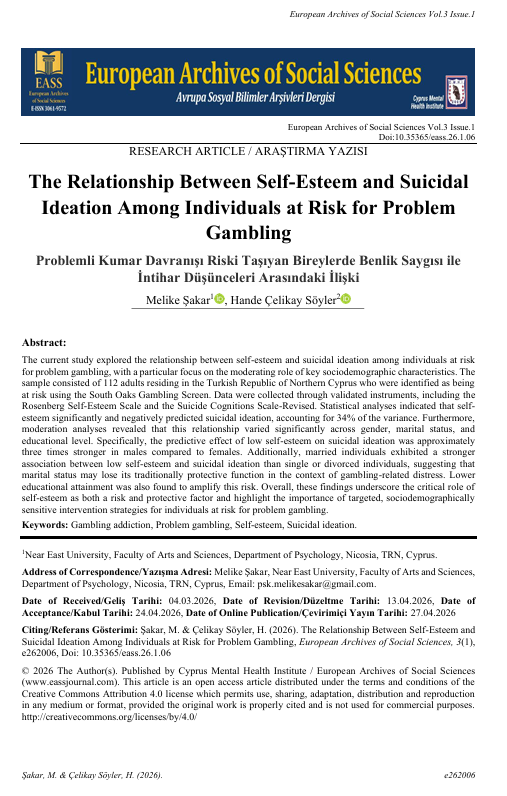
The Relationship Between Self-Esteem and Suicidal Ideation Among Individuals at Risk for Problem Gambling
DOI:
https://doi.org/10.35365/eass.26.1.06Keywords:
Problem gambling, Self-esteem, Suicidal ideation, Gambling addictionAbstract
The current study explored the relationship between self-esteem and suicidal ideation among individuals at risk for problem gambling, with a particular focus on the moderating role of key sociodemographic characteristics. The sample consisted of 112 adults residing in the Turkish Republic of Northern Cyprus who were identified as being at risk using the South Oaks Gambling Screen. Data were collected through validated instruments, including the Rosenberg Self-Esteem Scale and the Suicide Cognitions Scale-Revised. Statistical analyses indicated that self-esteem significantly and negatively predicted suicidal ideation, accounting for 34% of the variance. Furthermore, moderation analyses revealed that this relationship varied significantly across gender, marital status, and educational level. Specifically, the predictive effect of low self-esteem on suicidal ideation was approximately three times stronger in males compared to females. Additionally, married individuals exhibited a stronger association between low self-esteem and suicidal ideation than single or divorced individuals, suggesting that marital status may lose its traditionally protective function in the context of gambling-related distress. Lower educational attainment was also found to amplify this risk. Overall, these findings underscore the critical role of self-esteem as both a risk and protective factor and highlight the importance of targeted, sociodemographically sensitive intervention strategies for individuals at risk for problem gambling.
References
Armoon, B., Griffiths, M. D., Mohammadi, R., & Ahounbar, E. (2023). Suicidal behaviors and associated factors among individuals with gambling disorders: A meta-analysis. Journal of Gambling Studies, 39(2), 751–777. https://doi.org/10.1007/s10899-023-10188-0
Borges, G., Nock, M. K., Abad, J. M. H., Hwang, I., Sampson, N. A., Alonso, J., ... & Kessler, R. C. (2010). Twelve-month prevalence of and risk factors for suicide attempts in the WHO World Mental Health Surveys. The Journal of Clinical Psychiatry, 71(12), 1617–1628.
https://doi.org/10.4088/JCP.08m04967blu.
Brezo, J., Paris, J., & Turecki, G. (2006). Personality traits as correlates of suicidal ideation, suicide attempts, and suicide completions: A systematic review. Acta Psychiatrica Scandinavica, 113(3), 180–206. https://doi.org/10.1111/j.1600-0447.2005.00702.x.
Burke, T. A., Connolly, S. L., Hamilton, J. L., Stange, J. P., Abramson, L. Y., & Alloy, L. B. (2016). Cognitive risk and protective factors for suicidal ideation: A two year longitudinal study in adolescence. Journal of Abnormal Child Psychology, 44(6), 1145–1160. https://doi.org/10.1007/s10802-015-0104-x.
Chen, W., Yang, T., & Luo, J. (2022). Core self-evaluation and subjective wellbeing: A moderated mediation model. Frontiers in Public Health, 10, 1036071.
https://doi.org/10.3389/fpubh.2022.1036071.
Choi, J., & Kim, K. (2021). The relationship between impulsiveness, self-esteem, irrational gambling belief and problem gambling moderating effects of gender. International Journal of Environmental Research and Public Health, 18(10), 5180. https://doi.org/10.3390/ijerph18105180.
Cohen, J. (1992). A power primer. Psychological Bulletin, 112(1), 155–159. https://doi.org/10.1037/0033-2909.112.1.155.
Çavuş, F., Çıvgın, U. & Yorulmaz, E. (2023). The mediating role of self-esteem in the relationship between impulsivity, shame and gambling severity. Cyprus Turkish Journal of Psychiatry & Psychology, 5(3): 228-238.https://doi.org/10.35365/ctjpp.23.3.05.
Çifci, F., Nikhat, A., & Shen, Y. (2025). When hope fades: Considering self-esteem, depression, social support, loneliness in the context of suicide prevention. Black Sea Journal of Health Science, 8(1), 21–33.
https://doi.org/10.19127/bshealthscience.1509522.
Çuhadaroğlu, F. (1986). Adölesanlarda benlik saygısı. Uzmanlık Tezi, Hacettepe Üniversitesi, Ankara.
Di Carlo, F., Pettorruso, M., Santorelli, M., Cocciolillo, F., d’Andrea, G., Di Nicola, M., … Di Giuda, D. (2024). Linking striatal dopaminergic asymmetry with personality traits: Insights from gambling disorder. Journal of Gambling Studies, 40(4), 2189–2200. https://doi.org/10.1007/s10899-024-10311-9.
Duvarcı, İ., & Varan, A. (2001). South Oaks Kumar Tarama Testi Türkçe formu güvenirlik ve geçerlik çalışması. Türk Psikiyatri Dergisi, 12(1), 34–45. Retrieved from: https://www.turkpsikiyatri.com
Fraenkel, J. R., & Wallen, N. E. (2019). How to design and evaluate research in education (7th ed.). McGraw Hill Higher Education. ISBN-13: 978-0078024290
Franklin, J. C., Ribeiro, J. D., Bentley, K. H., Huang, X., Musacchio, K. M., Chang, B. P., ... & Nock, M. K. (2017). Risk factors for suicidal thoughts and behaviors: A meta-analysis of 50 years of research. Psychological Bulletin, 143(2), 187–232. https://doi.org/10.1037/bul0000084.
Hayes, A. F. (2018). Introduction to mediation, moderation, and conditional process analysis: A regression-based approach (2nd ed.). Guilford Publications. ISBN-13: 978-1462534654
Horvath, Z., Paksi, B., Fernández-Aranda, F., Jiménez-Murcia, S., & Demetrovics, Z. (2023). The predictive role of tolerance and health problems in problem gambling: A cross-sectional and cross-lagged network analyses. Journal of Gambling Studies, 39(4), 1781–1798. https://doi.org/10.1007/s10899-023-10191-5
Karlsson, A., & Håkansson, A. (2023). Corrigendum to: Gambling disorder, increased mortality, suicidality, and associated comorbidity: A longitudinal nationwide register study. Journal of Behavioral Addictions, 12(1), 302. https://doi.org/10.1556/2006.2023.10000.
Kristensen, J. H., Pallesen, S., Bauer, J., Leino, T., Griffiths, M. D., & Erevik, E. K. (2024). Suicidality among individuals with gambling problems: A meta-analytic literature review. Psychological Bulletin, 150(1), 82–106. https://doi.org/10.1037/bul0000411.
Langham, E., Thorne, H., Browne, M., Donaldson, P., Rose, J., & Rockloff, M. (2016). Understanding gambling related harm: a proposed definition, conceptual framework, and taxonomy of harms. BMC Public Health, 16(1), 80. https://doi.org/10.1186/s12889-016-2747-0.
Lesieur, H. R., & Blume, S. B. (1987). The South Oaks Gambling Screen (SOGS): A new instrument for the identification of pathological gamblers. The American Journal of Psychiatry, 144(9), 1184–1188. https://doi.org/10.1176/ajp.144.9.1184.
Lippo, F., Madeddu, F., Fornaro, M., & Calati, R. (2022). The association between self-esteem and suicidal risk: a meta-analysis. European Psychiatry: The Journal of the Association of European Psychiatrists, 65(S1), S835–S835. https://doi.org/10.1192/j.eurpsy.2022.2162
Manani, P., & Sharma, S. (2013). Self esteem and suicidal ideation: A correlational study. MIER Journal of Educational Studies, Trends & Practices, 3(1), 75–83. Retrieved from: https://www.mierjs.in
Penfold, K., Nicklin, L. L., Chadwick, D., & Lloyd, J. (2024). Gambling harms, stigmatisation and discrimination: A qualitative naturalistic forum analysis. PloS One, 19(12), e0315377. https://doi.org/10.1371/journal.pone.0315377.
Rosenberg, M. (1965). Society and the Adolescent Self-Image. Princeton, NJ: Princeton University Press. ISBN (13): 978-0691649443
Rudd, M. D., Joiner, T. E., & Rajab, M. H. (2008). Suicide Cognitions Scale–Revised (SCS-R). In M. D. Rudd, T. E. Joiner, & M. H. Rajab, Treating suicidal behavior: An effective, time-limited approach (pp. 289-291). The Guilford Press. ISBN-13: 978-1593858285
Seo, E. H., Yang, H.-J., Kim, S.-G., & Yoon, H.-J. (2022). Ego-resiliency moderates the risk of depression and social anxiety symptoms on suicidal ideation in medical students. Annals of General Psychiatry, 21(1), 19. https://doi.org/10.1186/s12991-022-00399-x.
Teismann, T., Joiner, T. E., Robison, M., & Brailovskaia, J. (2024). Self-burdensomeness, self-esteem and suicidal ideation. Cognitive Therapy and Research, 48, 398–405.
https://doi.org/10.1007/s10608-024-10477-x.
Wardle, H., Degenhardt, L., Marionneau, V., Reith, G., Livingstone, C., Sparrow, M., … Saxena, S. (2024). The Lancet Public Health Commission on gambling. The Lancet. Public Health, 9(11), e950–e994. https://doi.org/10.1016/S2468-2667(24)00167-1.
Downloads
Online Publication Date
How to Cite
Issue
Section
License
Copyright (c) 2026 European Archives of Social Sciences

This work is licensed under a Creative Commons Attribution 4.0 International License.






 The journal is licensed under a