Problemli Kumar Davranışı Riski Taşıyan Bireylerde Benlik Saygısı ile İntihar Düşünceleri Arasındaki İlişki
DOI:
https://doi.org/10.35365/eass.26.1.06Anahtar Kelimeler:
Kumar bağımlılığı, Problemli kumar, Benlik saygısı, İntihar DüşüncesiÖzet
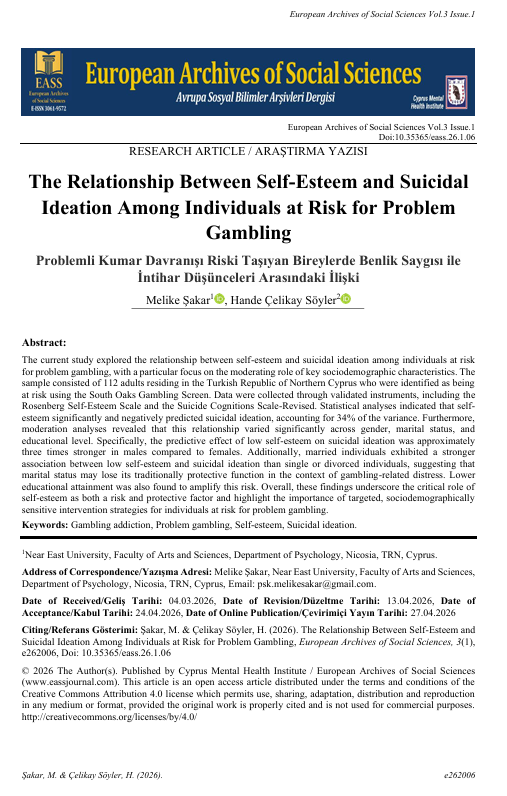
Bu çalışmada, kumar oynama riski taşıyan bireyler arasında benlik saygısı ile intihar düşüncesi arasındaki ilişki ve sosyodemografik özelliklerin düzenleyici rolü incelenmiştir. Araştırmanın örneklemini, Güney Oaks Kumar Tarama Testi kullanılarak risk altında olduğu belirlenen, Kuzey Kıbrıs Türk Cumhuriyeti’nde yaşayan 112 yetişkin oluşturmaktadır. Veriler, Rosenberg Benlik Saygısı Ölçeği ve İntihar Biliş Ölçeği kullanılarak toplanmıştır. Elde edilen bulgular, benlik saygısının intihar düşüncesini negatif yönde ve anlamlı biçimde yordadığını ve toplam varyansın %34’ünü açıkladığını göstermiştir. Ayrıca bu ilişkinin cinsiyet, medeni durum ve eğitim düzeyi gibi sosyodemografik değişkenler tarafından anlamlı şekilde düzenlendiği belirlenmiştir. Düşük benlik saygısının intihar düşüncesi üzerindeki etkisinin erkeklerde kadınlara kıyasla yaklaşık üç kat daha güçlü olduğu saptanmıştır. Medeni duruma göre yapılan analizlerde, evli bireylerin düşük benlik saygısı ile intihar düşüncesi arasında daha güçlü bir ilişki sergilediği görülmüştür. Bu durum, evliliğin kumar riski bağlamında koruyucu işlevini yitirerek bir stres kaynağına dönüşebileceğine işaret etmektedir. Ayrıca düşük eğitim düzeyinin bu riski artırıcı bir rol oynadığı belirlenmiştir. Bununla birlikte, elde edilen sonuçlar benlik saygısının hem koruyucu hem de risk artırıcı bir psikolojik değişken olarak önemli bir işlev gördüğünü ortaya koymaktadır. Bu bulgular, benlik saygısını güçlendirmeye yönelik müdahalelerin önemini vurgulamakta ve özellikle erkek, evli ve düşük eğitim düzeyine sahip bireylere yönelik hedeflenmiş önleme stratejilerinin geliştirilmesi gerektiğini ortaya koymaktadır.
Referanslar
Armoon, B., Griffiths, M. D., Mohammadi, R., & Ahounbar, E. (2023). Suicidal behaviors and associated factors among individuals with gambling disorders: A meta-analysis. Journal of Gambling Studies, 39(2), 751–777. https://doi.org/10.1007/s10899-023-10188-0
Borges, G., Nock, M. K., Abad, J. M. H., Hwang, I., Sampson, N. A., Alonso, J., ... & Kessler, R. C. (2010). Twelve-month prevalence of and risk factors for suicide attempts in the WHO World Mental Health Surveys. The Journal of Clinical Psychiatry, 71(12), 1617–1628.
https://doi.org/10.4088/JCP.08m04967blu.
Brezo, J., Paris, J., & Turecki, G. (2006). Personality traits as correlates of suicidal ideation, suicide attempts, and suicide completions: A systematic review. Acta Psychiatrica Scandinavica, 113(3), 180–206. https://doi.org/10.1111/j.1600-0447.2005.00702.x.
Burke, T. A., Connolly, S. L., Hamilton, J. L., Stange, J. P., Abramson, L. Y., & Alloy, L. B. (2016). Cognitive risk and protective factors for suicidal ideation: A two year longitudinal study in adolescence. Journal of Abnormal Child Psychology, 44(6), 1145–1160. https://doi.org/10.1007/s10802-015-0104-x.
Chen, W., Yang, T., & Luo, J. (2022). Core self-evaluation and subjective wellbeing: A moderated mediation model. Frontiers in Public Health, 10, 1036071.
https://doi.org/10.3389/fpubh.2022.1036071.
Choi, J., & Kim, K. (2021). The relationship between impulsiveness, self-esteem, irrational gambling belief and problem gambling moderating effects of gender. International Journal of Environmental Research and Public Health, 18(10), 5180. https://doi.org/10.3390/ijerph18105180.
Cohen, J. (1992). A power primer. Psychological Bulletin, 112(1), 155–159. https://doi.org/10.1037/0033-2909.112.1.155.
Çavuş, F., Çıvgın, U. & Yorulmaz, E. (2023). The mediating role of self-esteem in the relationship between impulsivity, shame and gambling severity. Cyprus Turkish Journal of Psychiatry & Psychology, 5(3): 228-238.https://doi.org/10.35365/ctjpp.23.3.05.
Çifci, F., Nikhat, A., & Shen, Y. (2025). When hope fades: Considering self-esteem, depression, social support, loneliness in the context of suicide prevention. Black Sea Journal of Health Science, 8(1), 21–33.
https://doi.org/10.19127/bshealthscience.1509522.
Çuhadaroğlu, F. (1986). Adölesanlarda benlik saygısı. Uzmanlık Tezi, Hacettepe Üniversitesi, Ankara.
Di Carlo, F., Pettorruso, M., Santorelli, M., Cocciolillo, F., d’Andrea, G., Di Nicola, M., … Di Giuda, D. (2024). Linking striatal dopaminergic asymmetry with personality traits: Insights from gambling disorder. Journal of Gambling Studies, 40(4), 2189–2200. https://doi.org/10.1007/s10899-024-10311-9.
Duvarcı, İ., & Varan, A. (2001). South Oaks Kumar Tarama Testi Türkçe formu güvenirlik ve geçerlik çalışması. Türk Psikiyatri Dergisi, 12(1), 34–45. Retrieved from: https://www.turkpsikiyatri.com
Fraenkel, J. R., & Wallen, N. E. (2019). How to design and evaluate research in education (7th ed.). McGraw Hill Higher Education. ISBN-13: 978-0078024290
Franklin, J. C., Ribeiro, J. D., Bentley, K. H., Huang, X., Musacchio, K. M., Chang, B. P., ... & Nock, M. K. (2017). Risk factors for suicidal thoughts and behaviors: A meta-analysis of 50 years of research. Psychological Bulletin, 143(2), 187–232. https://doi.org/10.1037/bul0000084.
Hayes, A. F. (2018). Introduction to mediation, moderation, and conditional process analysis: A regression-based approach (2nd ed.). Guilford Publications. ISBN-13: 978-1462534654
Horvath, Z., Paksi, B., Fernández-Aranda, F., Jiménez-Murcia, S., & Demetrovics, Z. (2023). The predictive role of tolerance and health problems in problem gambling: A cross-sectional and cross-lagged network analyses. Journal of Gambling Studies, 39(4), 1781–1798. https://doi.org/10.1007/s10899-023-10191-5
Karlsson, A., & Håkansson, A. (2023). Corrigendum to: Gambling disorder, increased mortality, suicidality, and associated comorbidity: A longitudinal nationwide register study. Journal of Behavioral Addictions, 12(1), 302. https://doi.org/10.1556/2006.2023.10000.
Kristensen, J. H., Pallesen, S., Bauer, J., Leino, T., Griffiths, M. D., & Erevik, E. K. (2024). Suicidality among individuals with gambling problems: A meta-analytic literature review. Psychological Bulletin, 150(1), 82–106. https://doi.org/10.1037/bul0000411.
Langham, E., Thorne, H., Browne, M., Donaldson, P., Rose, J., & Rockloff, M. (2016). Understanding gambling related harm: a proposed definition, conceptual framework, and taxonomy of harms. BMC Public Health, 16(1), 80. https://doi.org/10.1186/s12889-016-2747-0.
Lesieur, H. R., & Blume, S. B. (1987). The South Oaks Gambling Screen (SOGS): A new instrument for the identification of pathological gamblers. The American Journal of Psychiatry, 144(9), 1184–1188. https://doi.org/10.1176/ajp.144.9.1184.
Lippo, F., Madeddu, F., Fornaro, M., & Calati, R. (2022). The association between self-esteem and suicidal risk: a meta-analysis. European Psychiatry: The Journal of the Association of European Psychiatrists, 65(S1), S835–S835. https://doi.org/10.1192/j.eurpsy.2022.2162
Manani, P., & Sharma, S. (2013). Self esteem and suicidal ideation: A correlational study. MIER Journal of Educational Studies, Trends & Practices, 3(1), 75–83. Retrieved from: https://www.mierjs.in
Penfold, K., Nicklin, L. L., Chadwick, D., & Lloyd, J. (2024). Gambling harms, stigmatisation and discrimination: A qualitative naturalistic forum analysis. PloS One, 19(12), e0315377. https://doi.org/10.1371/journal.pone.0315377.
Rosenberg, M. (1965). Society and the Adolescent Self-Image. Princeton, NJ: Princeton University Press. ISBN (13): 978-0691649443
Rudd, M. D., Joiner, T. E., & Rajab, M. H. (2008). Suicide Cognitions Scale–Revised (SCS-R). In M. D. Rudd, T. E. Joiner, & M. H. Rajab, Treating suicidal behavior: An effective, time-limited approach (pp. 289-291). The Guilford Press. ISBN-13: 978-1593858285
Seo, E. H., Yang, H.-J., Kim, S.-G., & Yoon, H.-J. (2022). Ego-resiliency moderates the risk of depression and social anxiety symptoms on suicidal ideation in medical students. Annals of General Psychiatry, 21(1), 19. https://doi.org/10.1186/s12991-022-00399-x.
Teismann, T., Joiner, T. E., Robison, M., & Brailovskaia, J. (2024). Self-burdensomeness, self-esteem and suicidal ideation. Cognitive Therapy and Research, 48, 398–405.
https://doi.org/10.1007/s10608-024-10477-x.
Wardle, H., Degenhardt, L., Marionneau, V., Reith, G., Livingstone, C., Sparrow, M., … Saxena, S. (2024). The Lancet Public Health Commission on gambling. The Lancet. Public Health, 9(11), e950–e994. https://doi.org/10.1016/S2468-2667(24)00167-1.
İndir
Çevrimiçi Yayın Tarihi
Nasıl Atıf Yapılır
Sayı
Bölüm
Lisans
Telif Hakkı (c) 2026 Avrupa Sosyal Bilimler Arşivleri Dergisi

Bu çalışma Creative Commons Attribution 4.0 International License ile lisanslanmıştır.






 Dergimizde yayımlanan makaleler,